
The Data Highway: How FHIR Saved Our Launch and Our Sanity
How a FHIR-native architecture and Structured Data Capture (SDC) helped us survive an FDA mandate and eliminate the 'Translation Tax' between clinical and engineering teams.
FHIR
SDC
EDC
In a recent project, building a new clinical platform that combines ePRO, EDC, and medical image analysis, I’ve had a recurring debate with a colleague about FHIR. His position: FHIR is an interoperability protocol — great for exchanging data between institutions, but not something you build your internal domain model on. My position: that distinction, while technically real, is the wrong one to optimize around — especially in 2026.
This is my attempt to write that argument down properly.
The platform we’re building needed to do three things at once: collect patient-reported outcomes (ePRO), support electronic data capture (EDC), and store medical images alongside AI-generated measurements and human reads.
My architecture decision was to go FHIR-native across the board:
ImagingStudy for study metadata, Observation for AI and human measurements, DiagnosticReport to tie it togetherThe result was fast iteration, a unified data model across all three platform components, and zero translation layer between modules.
The objection from my colleague was articulate and not entirely wrong:
“FHIR is the right standard — but what these sources describe is FHIR as an interoperability protocol between institutions. They do not describe it as an internal domain model for application development. The regulatory requirement is met by a clean outbound/inbound layer. Everything beyond that is an architecture choice.”
This is a reasonable position on its face. And the distinction between FHIR-as-protocol and FHIR-as-domain-model is a real one. So let me address it directly.
The most common misconception about FHIR — especially among developers coming from non-web backgrounds — is that it’s essentially HL7 v2 with a REST wrapper: a message format for moving data between systems, not something you build on internally.
That’s not what FHIR is.
FHIR defines a logical domain model (the resources), a REST interaction model (how you read, write, search, and version those resources), and a content standard (Implementation Guides that define exactly what data elements mean in a given context). Tools like Aidbox exist precisely to persist that model natively — making FHIR your internal store, not just your outbound format.
The FDA’s PQ/CMC Implementation Guide is a useful concrete example. It explicitly defines data elements: batch formulas, quality specifications, submission content structure. It is built on eCTD, which is itself a content and submission standard. That IG is not describing how to move data between institutions. It is defining what the data is. That is a domain model.
Siemens, Philips, and Mayo Clinic are all using FHIR this way for medical imaging — not as a transport envelope between hospitals, but as the semantic layer on top of DICOM for storing measurements, AI outputs, and structured reports. The pattern is ImagingStudy for the study, Observation for each measurement, DiagnosticReport to assemble the clinical picture.
One of the lingering objections to using FHIR as an application storage layer has been analytical querying. FHIR’s nested, resource-centric structure is expressive and clinically rich — but it’s not what analysts or reporting pipelines expect. Traditionally, getting tabular data out of a FHIR store meant custom extraction logic or, worse, a separate reporting database kept in sync.
SQL on FHIR closes that gap entirely.
The SQL on FHIR specification defines a standard way to create flat, tabular ViewDefinitions directly over FHIR resources. You define a view once — say, all Observation resources for a given LOINC code — and query it with standard SQL. No ETL, no synchronization, no separate model to maintain.
For a platform like this, the impact is significant. It means:
Combined with a FHIR-native backend like FHIR CDR — which supports SQL on FHIR natively — this makes FHIR a genuinely robust application storage layer, not just a model you tolerate for regulatory reasons. You get the clinical expressiveness of FHIR resources and the query ergonomics of SQL, in the same system, with no synchronization problem to manage.
The “FHIR is only for transport” argument was always weakest on persistence. SQL on FHIR removes the last reasonable objection.
The most concrete argument I have isn’t theoretical. It’s a scar.
In a previous iteration of the platform there was a running ETL layer. It exists because the internal data model and the outbound format didn’t align. Every time data needed to move from one to the other, it had to be transformed, mapped, and validated. That’s maintenance cost, that’s a failure surface, and that’s where bugs live.
My colleague’s proposal — a “clean outbound/inbound layer” — is exactly that architecture. He’s proposing we build it again, deliberately, knowing what it costs.
The FHIR-native approach eliminates that layer by making the internal model and the outbound format the same thing. There is no mapping step. There is no place for that class of bug to exist.
In Germany, this isn’t a philosophical choice about future-proofing — it’s a current operational reality.
The ePA (elektronische Patientenakte) and DiGA (Digitale Gesundheitsanwendungen) infrastructure runs on FHIR today. Patients have a legal right to their data in a portable format, and in Germany, that format is FHIR.
If you build a custom internal domain model, you’re producing FHIR twice: once as an output step when data leaves your system, and again every time you need to connect to national infrastructure or respond to a patient data request. That’s double the work and double the places things can go wrong.
Building natively in FHIR isn’t ideological. It’s alignment with the infrastructure you’re required to connect to.
My colleague said: “Nothing in FHIR comes for free.”
He’s right. But nothing in a custom domain model comes for free either — and a custom model gives you none of the tooling, validation, terminology binding, provenance tracking, or regulatory traceability that FHIR provides as a base layer.
You’re not choosing between expensive and cheap. You’re choosing which costs to carry — and whether those costs come with benefits attached.
FHIR’s costs come with: a standardized schema you don’t have to invent, built-in versioning and provenance, terminology binding to SNOMED/LOINC/ICD, SQL-queryable analytics via SQL on FHIR, and compliance alignment with FDA, ePA and DiGA out of the box.
A custom model’s costs come with: a schema you maintain forever, a mapping layer to every standard you eventually need to connect to, and a rewrite when the regulatory landscape moves — which it is.
One thing I didn’t expect when making this architectural choice: how much the internal debate would cost.
A year of relitigating the same decision is expensive. Not because the debate is wrong to have — it isn’t — but because once an architecture is decided and implementation has started, the cost of the debate shifts. It’s no longer about finding the best answer. It’s about governance: who has the authority to make the call, and how do you close it so the team can move.
If you’re an architect in a similar situation, my honest advice: make the decision, document it clearly, define the interfaces each component needs to implement, and escalate quickly if someone keeps reopening it. A developer doesn’t need to agree with FHIR philosophically to output a JSON structure to a defined schema. That’s the interface. Spec it and ship it.
FHIR is not just a protocol. It is a domain model, a content standard, and — when you use the right tooling — a robust application storage layer. SQL on FHIR removes the last reasonable objection to using it as such, giving you clinical expressiveness and SQL query ergonomics in the same system, with no ETL layer in between.
The “interop only” view is a relic of HL7 v2 thinking that doesn’t reflect how the ecosystem has evolved.
For a platform like this — combining ePRO, EDC, and medical imaging in a German regulatory context — going FHIR-native wasn’t the fashionable choice. It was the pragmatic one. We get a unified data model, no ETL layer, compliance with ePA and DiGA out of the box, SQL-based analytics without a data warehouse, and a clear interface for every component including the imaging backend.
The debate was worth having. But the answer was right.
How a FHIR-native architecture and Structured Data Capture (SDC) helped us survive an FDA mandate and eliminate the 'Translation Tax' between clinical and engineering teams.
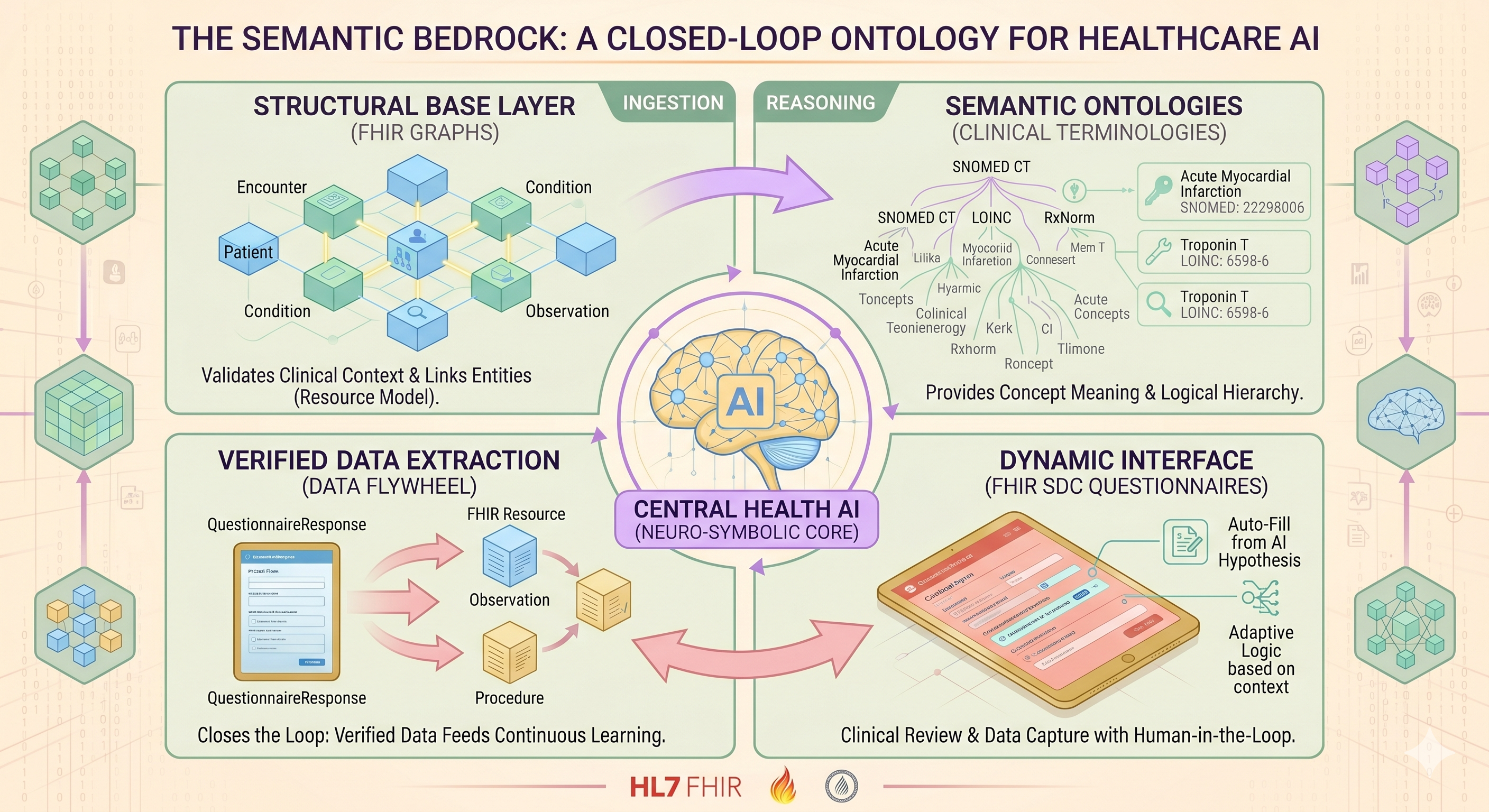
How to move past simple interoperability and treat FHIR and clinical ontologies as the essential base layer for LLM grounding and automated data capture.

Plain text logs are for humans; structured logs are for automation. Learn how to implement JSON logging that makes debugging FHIR traffic easy.
Protecting patient data is non-negotiable. Learn how to implement industry-standard Bearer token validation using external Identity Providers.
A FHIR server is more than a database—it's a clinical translator. Explore how we've extended terminology support for expansions, lookups, and validation.

Master the art of managing long-running FHIR tasks like Bulk Export and Reindexing, and learn how to implement your own scheduled jobs.

Stop flying blind. Learn how to integrate Prometheus and Grafana to gain real-time insights into your FHIR server's performance and health.

Learn how to dynamically manage FHIR Implementation Guides (IGs) without restarting your server, ensuring your data models stay up to date.