
Breaking the Mold: The Case for Custom FHIR Resources
Exploring the strategic value of Logical Models in FHIR architecture: when to use them, why they matter, and how to implement them using FHIR Shorthand (FSH).
FHIR
Architecture
FSH
FISH (Fluent Implementation Syntax) has transformed how we define FHIR artifacts, but its real power emerges when combined with logical models—a pairing that enables sophisticated data modeling scenarios that would be unwieldy to express in profile-first approaches. This article explores how logical models and mapping work together to construct complex, testable data models.
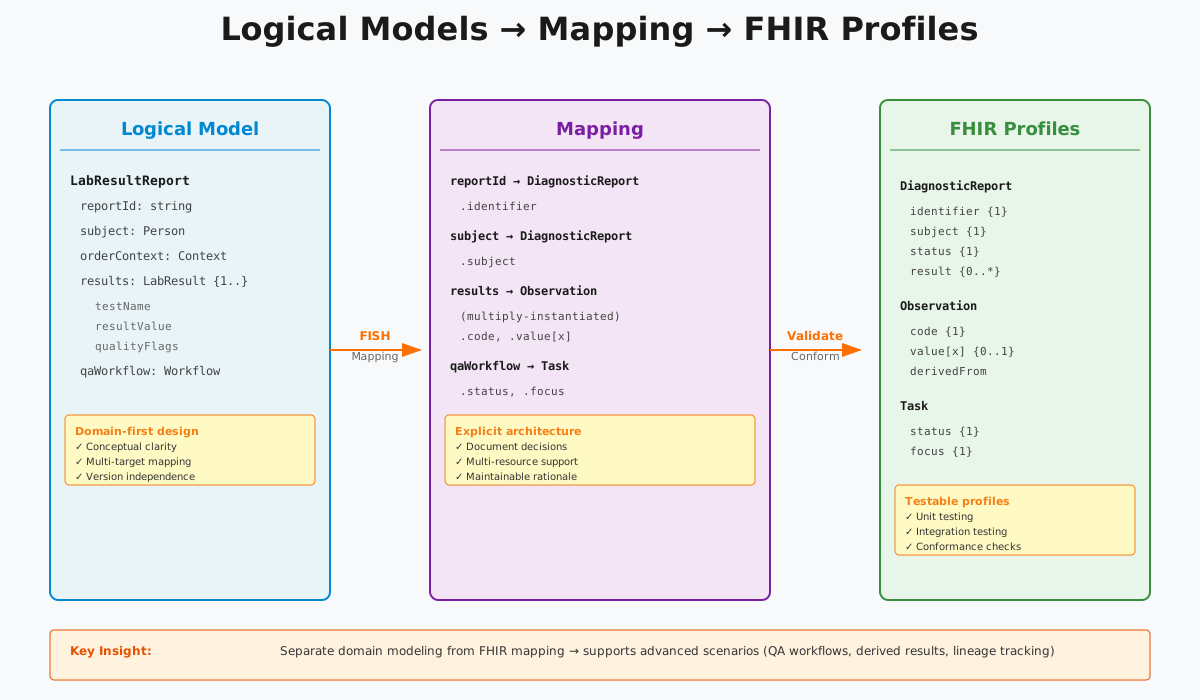
Logical models represent domain concepts independent of FHIR’s predefined structure. Rather than immediately constraining a Patient or Observation resource, a logical model describes what data you actually need from your use case. This separation of concerns is powerful: you design the conceptual model first, then map it to FHIR later—or map it to multiple FHIR versions, regulatory profiles, or even non-FHIR targets.
Consider a laboratory result reporting scenario. Your domain requires:
A pure profile-first approach forces you to immediately decide which FHIR resources carry which concepts. A logical model lets you express the domain structure cleanly, then strategize mapping.
FISH syntax for logical models is direct:
Logical: LabResultReport
Title: "Laboratory Result Report Logical Model"
Description: "Domain model for structured lab reporting"

* reportId: string "Unique report identifier"
* subject: Person "Subject of the report"
* orderContext: OrderContext "Lab order and request details"
* results: BackboneElement {0..} "Reported test results"
  * testName: CodeableConcept "Identification of the test performed"
  * resultValue: Quantity "Measured value"
  * refRange: Quantity {0..1} "Reference interval"
  * resultDate: dateTime "When the result was obtained"
  * qualityFlags: Coding {0..} "Quality indicators (suspected duplicate, critical value, etc.)"
* qaWorkflow: WorkflowStatus {0..1} "QA review state and sign-off"

Logical: Person
* identifier: Identifier {1..} "National ID, medical record number, etc."
* name: HumanName
* dateOfBirth: date {0..1}
* contact: ContactPoint {0..*}

Logical: OrderContext
* orderNumber: string
* orderDate: dateTime
* requestingProvider: Person
* clinicalIndication: CodeableConcept {0..1}
This logical model makes implicit assumptions explicit. It doesn’t force you into Observation + DiagnosticReport decomposition immediately—that’s a mapping decision, not a modeling decision.
Mapping connects logical model elements to FHIR resources. FISH supports ConceptMap-style expressions that document these connections:
Mapping: LabReportToFHIR
Source: LabResultReport
Target: "FHIR"
Title: "Logical Model to FHIR R4 Mapping"

* reportId -> "DiagnosticReport.identifier"
* subject -> "DiagnosticReport.subject"
* orderContext.orderNumber -> "DiagnosticReport.basedOn.identifier"
* orderContext.orderDate -> "DiagnosticReport.issued"
* orderContext.requestingProvider -> "DiagnosticReport.performer"
* results -> "Observation (multiply-instantiated)"
* results.testName -> "Observation.code"
* results.resultValue -> "Observation.value[x]"
* results.refRange -> "Observation.referenceRange.high and .low"
* results.resultDate -> "Observation.effective[x]"
* results.qualityFlags -> "Observation.status, Observation.interpretation, custom extension"
* qaWorkflow -> "DiagnosticReport.status + Task resource for pending review"
The mapping documents architectural decisions. Here, a single logical model becomes multiple FHIR resources: DiagnosticReport as the container, Observation for each result, and optionally Task for QA workflow. This is transparent in the mapping—implementers see the rationale rather than reverse-engineering it from nested profiles.
Real-world complexity emerges when you need to support multiple scenarios from one logical model. Consider:
Scenario 1: Direct Lab Reporting — A simple case where results flow from analyzer to ordering system.
Scenario 2: Multi-Step QA — Results enter pending state, pass through review workflows, then finalize.
Scenario 3: Derived Results — Some results are calculated from raw measurements; tracking lineage is critical for quality assurance.
Rather than create separate logical models for each, define variants within a single model and use conditional mapping:
Logical: LabResultReport
Title: "Laboratory Result Report with QA Variants"
Description: "Unified logical model supporting simple and complex workflows"

* reportId: string
* reportingMode: code {0..1} "Values: SIMPLE | QA_PENDING | DERIVED"
* subject: Person
* orderContext: OrderContext
* results: LabResult {1..}
  * testName: CodeableConcept
  * resultValue: Quantity
  * refRange: Quantity {0..1}
  * isDerived: boolean {0..1}
  * sourceResults: string {0..} "IDs of results used in derivation (only if isDerived=true)"
  * qualityFlags: Coding {0..}

Mapping: LabReportToFHIRWithVariants
Source: LabResultReport
Target: "FHIR"
Title: "Conditional mapping based on reporting mode"

* reportingMode = "SIMPLE" -> "DiagnosticReport.status = 'final'"
* reportingMode = "QA_PENDING" -> "DiagnosticReport.status = 'preliminary' + Task for review"
* reportingMode = "DERIVED" -> "Observation.derivedFrom = [references to source Observations]"
* isDerived = true -> "Observation.category = 'derived' (custom code)"
This approach scales: you add reporting modes, lineage tracking, and QA states to the logical model, making the domain assumptions explicit. Implementers building to the profile see these decisions documented in the mapping.
Validation spans three levels:
1. Logical Model Validation Ensure data conforms to logical model cardinality, data types, and constraints:
Instance: LabReportExample
InstanceOf: LabResultReport
Title: "Sample Lab Report"

* reportId = "LR-2024-001234"
* subject.identifier[0].system = "http://example.org/mrn"
* subject.identifier[0].value = "MRN-456789"
* subject.name[0].text = "Jane Doe"
* orderContext.orderNumber = "ORD-2024-5678"
* orderContext.orderDate = 2024-05-10T09:00:00Z
* results[0].testName = http://loinc.org#2345-7 "Glucose [mg/dL]"
* results[0].resultValue = 95 'mg/dL'
* results[0].resultDate = 2024-05-10T09:30:00Z
2. Mapping Validation Verify that mappings are complete and consistent. Tools like FHIR Mapping Language (FML) can formally specify transformations:
group LabReportToFHIR(source report: LabResultReport, target bundle: Bundle) {
  bundle.entry as entry then {
    report -> entry.resource = create("DiagnosticReport") as dr then {
      report.reportId -> dr.identifier;
      report.subject as subj -> dr.subject = create("Reference") as ref then {
        subj.identifier[0].value -> ref.identifier.value;
      };
    };
    report.results as result -> bundle.entry as obsEntry then {
      result -> obsEntry.resource = create("Observation") as obs then {
        result.testName -> obs.code;
        result.resultValue -> obs.value;
        result.isDerived = true -> obs.derivedFrom = ...;
      };
    };
  };
}
3. Profile Conformance Once mapped to FHIR profiles, instances must validate against both the logical model and the FHIR profile constraints:
Instance: LabReportDiagnosticReport
InstanceOf: DiagnosticReport
Title: "DiagnosticReport instance from LabReportExample mapping"

* identifier.system = "http://example.org/labrid"
* identifier.value = "LR-2024-001234"
* status = #final
* code = http://loinc.org#80567 "Clinical Laboratory Tests"
* subject = Reference(PatientFromReport)
* issued = 2024-05-10T09:30:00Z
* basedOn = Reference(ServiceRequest)
* result = Reference(GlucoseObservation)

Instance: GlucoseObservation
InstanceOf: Observation
* code = http://loinc.org#2345-7 "Glucose [mg/dL]"
* valueQuantity = 95 'mg/dL'
* status = #final
* effectiveDateTime = 2024-05-10T09:30:00Z
Validation tooling (FSH implementation guides, IG publishers) will catch mismatches: if the logical model says refRange is optional but the profile requires it, or if a mapping claims to populate a required field that the logical model leaves empty.
A robust testing approach combines:
Unit Tests: Does the logical model capture domain requirements accurately? Do instances populate correctly?
Integration Tests: Do mappings produce valid FHIR profiles? Do FHIR instances successfully conform?
Scenario Tests: Can you represent all three reporting modes (simple, QA-pending, derived) in both logical and FHIR forms?
Terminology Tests: Are all CodeableConcept bindings correct? Do quality flags map to the right codes?
Instance: TestSimpleReport
InstanceOf: LabResultReport
* reportingMode = #SIMPLE
* results[0].qualityFlags = http://example.org/flags#normal-operation
// Should map cleanly to DiagnosticReport.status = final

Instance: TestDerivedReport
InstanceOf: LabResultReport
* reportingMode = #DERIVED
* results[0].isDerived = true
* results[0].sourceResults[0] = "ResultID-111"
// Should produce Observation.derivedFrom references

Instance: TestQAPending
InstanceOf: LabResultReport
* reportingMode = #QA_PENDING
* qaWorkflow.reviewState = #pending_review
// Should map to preliminary status + Task creation
Logical models and FISH mappings work synergistically: logical models let you reason about domain data before committing to FHIR structure, while mappings document the architectural choices that bridge them. For advanced scenarios—lineage tracking, multi-step workflows, derived calculations—this separation allows you to scale complexity without drowning in constraint details.
The payoff is transparency: implementers see not just “here’s the profile,” but “here’s why we made these FHIR choices.” And testing becomes tractable: validate the logical model, validate the mapping, validate FHIR conformance—each layer is independently verifiable.
Start with a clean logical model. Make mapping decisions explicit. Test at all three levels. You’ll find that complex scenarios become manageable, and maintainability improves dramatically.
Exploring the strategic value of Logical Models in FHIR architecture: when to use them, why they matter, and how to implement them using FHIR Shorthand (FSH).

How to move beyond static test data by combining the scale of Synthea with the precision of Flexporter to build realistic, custom healthcare environments.

A deep dive into the three powerful methods for including graphical representations in FHIR Implementation Guides: Mermaid, PlantUML, and the new automated Class Diagrams.

Why treating FHIR as a domain model—not just a protocol—matters for clinical platforms, regulatory compliance, and team efficiency. Lessons from building a FHIR-native stack for ePRO, EDC, and imaging in a German regulatory context.
How a FHIR-native architecture and Structured Data Capture (SDC) helped us survive an FDA mandate and eliminate the 'Translation Tax' between clinical and engineering teams.
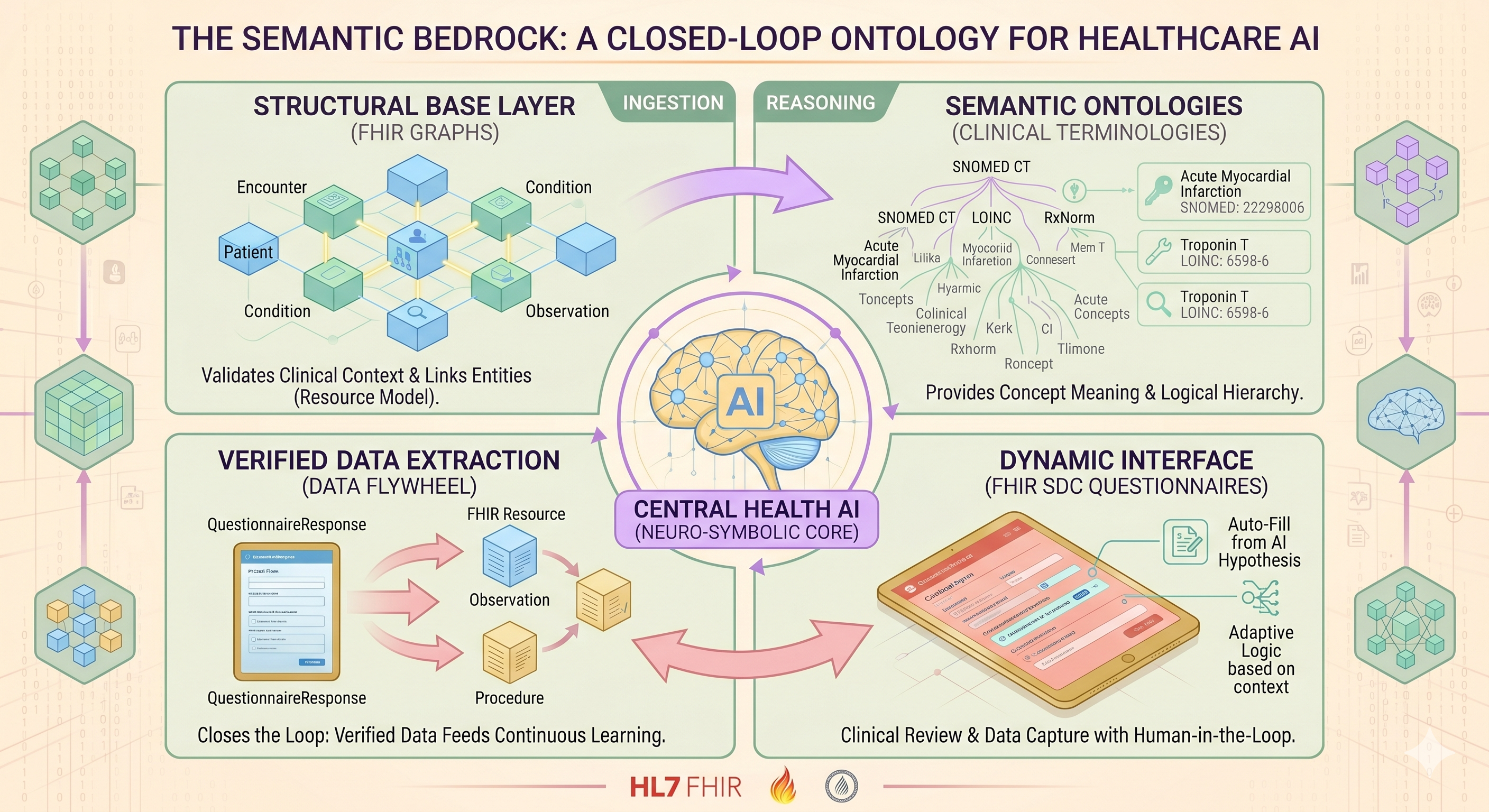
How to move past simple interoperability and treat FHIR and clinical ontologies as the essential base layer for LLM grounding and automated data capture.

Plain text logs are for humans; structured logs are for automation. Learn how to implement JSON logging that makes debugging FHIR traffic easy.
Protecting patient data is non-negotiable. Learn how to implement industry-standard Bearer token validation using external Identity Providers.